Kalebic Group
La neocorteccia è la parte del cervello coinvolta in una serie di funzioni cognitive superiori, tra cui il linguaggio. Durante l’evoluzione del cervello umano, la neocorteccia ha subito una forte espansione, che è considerata la base delle impareggiabili capacità cognitive degli esseri umani. I disturbi cognitivi spesso derivano da un’alterazione delle dimensioni o della forma della neocorteccia, a loro volta causati da difetti nella proliferazione delle cellule staminali neurali nelle prime fasi dello sviluppo cerebrale. Nel cervello adulto, le cellule tumorali possono sfruttare i medesimi meccanismi molecolari, causandone una proliferazione incontrollata. Tuttavia, le nostre conoscenze sui meccanismi alla base di questi processi sono ancora molto limitate.
La ricerca del Kalebic Group si concentra sui meccanismi molecolari e cellulari alla base dello sviluppo della neocorteccia umana e sulle loro implicazioni nei disturbi del neurosviluppo e nei tumori cerebrali. Nel contesto del neurosviluppo stiamo studiando le caratteristiche molecolari e cellulari delle cellule staminali neurali che, se compromesse, possono comportare un’alterazione delle dimensioni e della forma della neocorteccia, portando a disabilità intellettive, tra cui la sindrome di Down. Nel contesto dei tumori cerebrali, siamo interessati alla biologia molecolare e cellulare delle cellule staminali del glioblastoma per identificare nuovi bersagli associati alla proliferazione e all’invasività del cancro.
Il nostro gruppo adotta un approccio multidisciplinare su tutte le scale biologiche, combinando tecniche molecolari e genetiche all’avanguardia, editing del genoma CRISPR/Cas9, imaging avanzato dal vivo e strumenti computazionali. Applichiamo queste tecniche a una varietà di sistemi modello, tra cui campioni primari umani, organoidi cerebrali e modelli animali.
Per richieste informali si prega di contattare nereo.kalebic@fht.org.
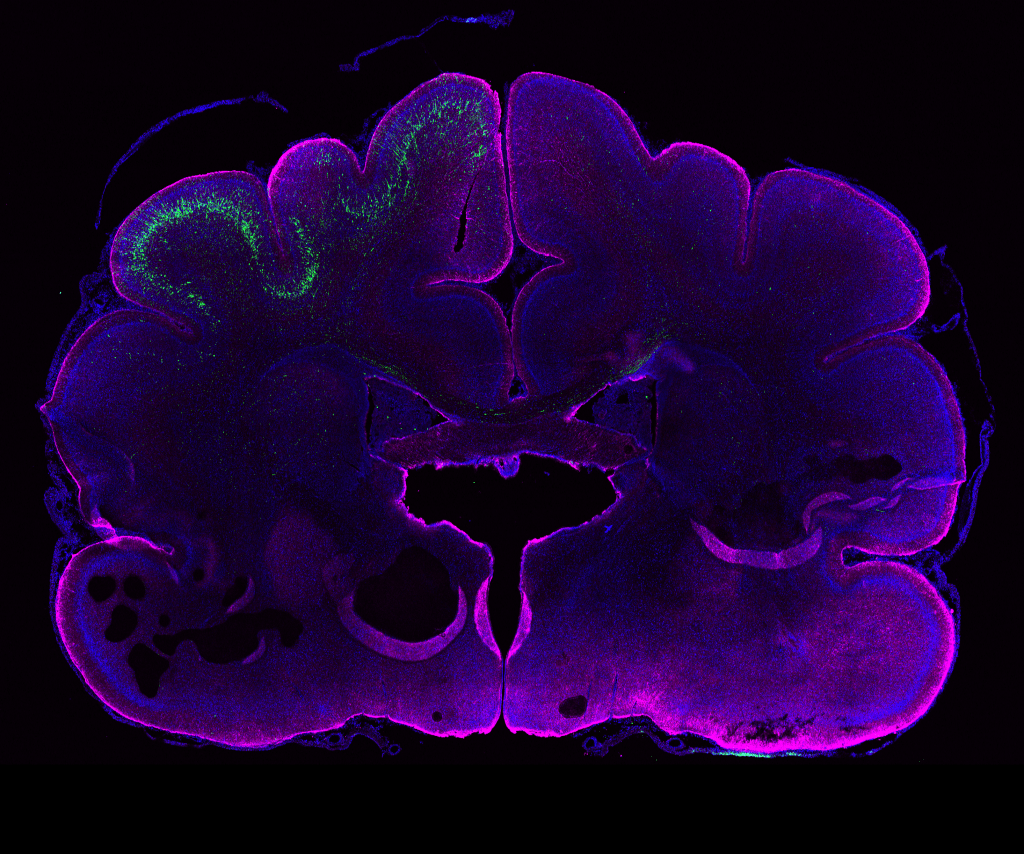
Didascalia della figura:
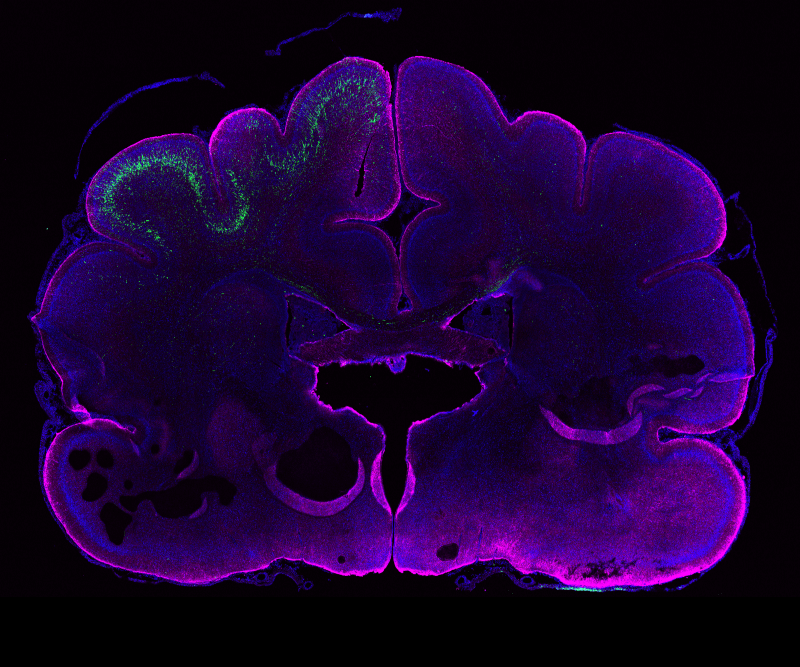
Manipolazione genetica nel cervello di furetto (età: giorno postnatale 16). Le cellule staminali neurali dell’emisfero sinistro sono state elettroporate in vivo 24 giorni prima. I neuroni GFP+ (verdi) hanno il corpo cellulare nell’emisfero elettroporato ed estendono i loro processi all’emisfero controlaterale. Magenta, GFAP (marcatore delle cellule gliali); blu, DAPI (nuclei).
Immagine tratta da: Kalebic et al., eLife 2018;7:e41241.
Membri del gruppo
-
 Nereo Kalebic
Research Group Leader -
 Carlotta Barelli
PhD Student -
 Ilaria Bertani
Senior Research Technician -
 Emanuele Capra
PhD Student -
 Nikola Cokorac
PhD Student -
 Stefania Faletti
Postdoc -
 Mewhanti Flaminia Kaluthantrige Don
Postdoc -
 Chiara Ossola
PhD Student -
 Lucas Pierre Van Endert
Undergraduate Intern -
 Luca Wagner
Undergraduate Intern
Pubblicazioni
-
06/2023 - EMBO Reports
DOT1L activity affects neural stem cell division mode and reduces differentiation and ASNS expression
Cortical neurogenesis depends on the balance between self-renewal and differentiation of apical progenitors (APs). Here, we study the epigenetic control of AP’s division mode by focusing on the enzymatic activity of the histone methyltransferase DOT1L. Combining lineage tracing with single-cell RNA sequencing of clonally related cells, we show at the cellular level that DOT1L inhibition […]
-
09/2022 - Science
Human TKTL1 implies greater neurogenesis in frontal neocortex of modern humans than Neanderthals
INTRODUCTION The evolutionary expansion of the neocortex and the concomitant increase in neuron production are considered to be a basis for the increase in cognitive abilities that occurred during human evolution. Endocast analyses reveal that the endocranial volume of modern humans and Neanderthals was similar, suggesting similar brain and neocortex size. But whether similar neocortex […]
-
06/2022 - Frontiers in Cell and Developmental Biology
Forebrain Organoids to Model the Cell Biology of Basal Radial Glia in Neurodevelopmental Disorders and Brain Evolution
The acquisition of higher intellectual abilities that distinguish humans from their closest relatives correlates greatly with the expansion of the cerebral cortex. This expansion is a consequence of an increase in neuronal cell production driven by the higher proliferative capacity of neural progenitor cells, in particular basal radial glia (bRG). Furthermore, when the proliferation of […]
-
01/2022 - Frontiers in Neuroscience
Roots of the Malformations of Cortical Development in the Cell Biology of Neural Progenitor Cells
The cerebral cortex is a structure that underlies various brain functions, including cognition and language. Mammalian cerebral cortex starts developing during the embryonic period with the neural progenitor cells generating neurons. Newborn neurons migrate along progenitors’ radial processes from the site of their origin in the germinal zones to the cortical plate, where they mature […]
-
09/2021 - Development
Inheritance and flexibility of cell polarity: a clue for understanding human brain development and evolution
Cell polarity is fundamentally important for understanding brain development. Here, we hypothesize that the inheritance and flexibility of cell polarity during neocortex development could be implicated in neocortical evolutionary expansion. Molecular and morphological features of cell polarity may be inherited from one type of progenitor cell to the other and finally transmitted to neurons. Furthermore, […]
 Previous page